Keith Hirsch’s CD Resource

Welcome to my web site! Here you will find information related to early pressings on compact disc. Included is an up-to-date list of my collection of these and other collectable CDs, along with pictures of some of my rare discs. I hope you find this site to be a useful resource!

An entry here on March 9, 2008 focused on the world’s first CD single, Dire Straits “Brothers in Arms”.  Not long after the release of that CD single, in 1986 to be specific, CD singles started appearing in the U.S.  One of the first CD singles issued in the U.S., and sometimes claimed to be the first, was a promotional issue from A&M of The Police “Don’t Stand So Close To Me ‘86”.  The single was issued to promote the 1986 remix of the hit song that was included on the first compilation of The Police entitled Every Breath You Take — The Singles.  The catalog number for this single is CD-17435.

This single was issued in a cardboard digipak and is, therefore, also one of the earliest CDs to be issued in a digipak.  Shown below are pictures of the disc as well as the front and back of the digipak.  The disc was pressed in the U.S. by Laservideo and bears a design akin to a white-label promotional 45 RPM record.  Note that the disc is labeled “For Promotion Not For Sale”.  This disc is very rare.


police-stand-single_500.jpg

The early U.S. CD single of The Police “Don’t Stand So Close To Me ‘86” (A&M, catalog number CD-17435).  The design on the disc bears resemblance to a white-label promotional 45 RPM record.  Note that it says “For Promotion Not For Sale” beneath the A&M logo at 3 o’clock.  The copyright date on the disc is 1986.


police-stand-single-digipak-front_500.jpg

The front of the cardboard digipak for the U.S. CD single of The Police “Don’t Stand So Close to Me ‘86”.  Shown is what appears to be a white-label promotional 45 RPM record for the song.


police-stand-single-digipak-back_500.jpg

The back of the cardboard digipak for the U.S. CD single of The Police “Don’t Stand So Close to Me ‘86”. Shown is the play side of a CD.  Although difficult to see in the picture, this particular disc has “Made in USA - Digital Audio Disc Corp.” stamped on the plastic ring, indicative of an early DADC plant pressing.  The CD single shown above was pressed by Laservideo.

The Edison CD Sampler

The first CD pressing plant to open in the United States was CBS/Sony’s Digital Audio Disc Corporation, or DADC, in Terre Haute, Indiana.  To commemorate the opening of the DADC plant in September 1984, CBS/Sony pressed two promotional titles in very limited quantities.  The discs were then distributed to select members of the media and music industry insiders.  The two commemorative titles were a version of Bruce Springsteen Born in the U.S.A. with red text on the disc instead of black and a collection of early Thomas Edison audio recordings entitled The Edison CD Sampler.

Featured here is The Edison CD Sampler, and shown below are pictures of the cover and the disc.  The cover shows a photo of Thomas Edison with his Edison Cylinder Phonograph, but in an attempt at humor, the photo was altered to show Edison holding a compact disc.  The back cover of the booklet provides credits and instructions on the proper handling of a compact disc.  The back cover also states the following: “This disc was issued to commemorate the opening of the Digital Audio Disc Corporation: September 21, 1984”.

As shown below, the disc bears a copyright date of 1984 and is labeled a promotional copy.  This disc represents a very rare piece of history from the introduction of the compact disc.


edison-sampler-cover_500.jpg

The cover for The Edison CD Sampler. Note that the photo of Thomas Edison has been modified to show him holding a compact disc.  A statement on the the back cover indicates that this disc was issued on September 21, 1984.


edison-sampler_500.jpg

The Edison CD Sampler.  The catalog number is ECDS-1, which is shown on the disc at 2 o’clock.  Stamped on the plastic ring is “Made in USA - Digital Audio Disc Corp.”, and the matrix code is “DIDX-135 11A2”.  Beneath the catalog number is the DADC plant ‘D’ logo and the words “Manufactured by Digital Audio Disc Corp. Terre Haute, Indiana, USA”.  Note the promotional statement and the copyright date of 1984 beneath the CD format logo.

In 1985, Vertigo, a sub-label of Phonogram, issued the world’s first CD single in Europe to promote the landmark Dire Straits album Brothers in Arms and the resulting world concert tour.  The four-track single featured long and short versions of the album’s title track, a portion of “Why Worry” from Brothers in Arms, and “Going Home”, a solo hit by Mark Knopfler.  This CD single was released in conjuction with the concert tour’s sponsor, Philips, a co-inventor of the CD format with Sony.

The “Brothers in Arms” CD single was pressed in West Germany by Polygram and was released under Vertigo catalog number 884 285-2.  Two variations of the CD single were released.  The variations are marked by a subtle difference on the front cover.  The first version has a concert tour date of 1985 in a blue triangle.  As the concert tour extended into 1986, the cover was modified with the new date, and the appearance of the triangle was improved with additional colors.  I have read that just 200 copies of the 1985 version were released, while only 500 copies of the 1986 version were released.  While I cannot verify these numbers, both versions are rare in my experience.

Shown below are pictures of the disc, the two cover variations, and the back insert.  Once again, the two versions of the CD single differ only by the cover.


brothers-in-arms-single_500.jpg

The world’s first CD single, Dire Straits “Brothers in Arms” (Vertigo, catalog number 884 285-2).  The disc was pressed in West Germany by Polygram.  The label design is very similar to the one used for original issues of the Brothers in Arms album CD, except for the single, the guitar motif is pink instead of blue.  Two versions of this CD single were issued that differ only by the date on the cover.  Thus, this disc was issued with both versions.


brothers-in-arms-single-85-cover_500.jpg

The first cover for the Dire Straits “Brothers in Arms” CD single.  Note the statement “Live in 85” in the blue triangle.  I have read that only 200 copies of the single with this cover were issued, but this has not been confirmed.


brothers-in-arms-single-86-cover_500.jpg

The second cover for the Dire Straits “Brothers in Arms” CD single.  Note the statement “Live in 86” in the multi-colored triangle.  As can be surmised, the cover was modifed as the Brothers in Arms concert tour extended into 1986.  I have read that only 500 copies of the single with this cover were issued, but as with the first cover version, I have not been able to confirm this.


brothers-in-arms-single-back-insert_500.jpg

The back insert for the Dire Straits “Brothers in Arms” CD single.  The track list is provided.  Printed in the bottom right corner is “Printed in West Germany” and “Made in West Germany”.  This back insert was used for the 1985 and 1986 versions of the CD single.

CBS/Sony opened the first commercial CD pressing plant in Japan in 1982.  In the early days of the CD, many record labels turned to CBS/Sony to press their discs.  As a way to track the many manufacturing projects in the plant, for both outside labels and their own, CBS/Sony developed a system of project identification codes.  These codes appeared on discs and inserts for many titles issued outside of Japan.  Additionally, this system was later applied to discs coming out of CBS/Sony’s Digital Audio Disc Corp. (DADC) plant in the U.S.  Common project identification codes with their definitions and/or uses are as follows:

  • DIDP: Digital Identification Project; DIDP numbers were used on CBS/Sony rock, pop, and jazz titles.
  • DIDC: Digital Identification Classical; DIDC numbers were used on CBS/Sony classical titles.
  • DIDX: Digital Identification External; DIDX numbers were used on non-CBS/Sony titles.
  • DIDZ: The definition of the ‘Z’ is unknown, but DIDZ numbers were used on non-CBS/Sony titles as an alternative to DIDX numbers.
  • DIDY: The definition of the ‘Y’ is unknown, but DIDY numbers were used on Columbia Record Club mail-order issues.

For the most part, a non-CBS/Sony title was assigned either a DIDX or a DIDZ number.  However, certain early A&M titles released in the U.S. were issued both numbers.  Discs are not found with both numbers.  Rather, two different issues exist, one with a DIDX number and one with a DIDZ number.  Both discs were pressed by CBS/Sony in Japan, and the discs and inserts are very similar in appearance.  The DIDX or DIDZ number appears on both the disc and the inserts.  It is presumed that the DIDZ discs were pressed first because the inserts in most cases were printed in Japan, whereas inserts with the DIDX discs were printed in the U.S.

Shown below are two early U.S. issues of Supertramp Breakfast in America with catalog number CD-3708.  Both discs were pressed by CBS/Sony and have “CSR COMPACT DISC” repeating in the plastic ring.  The top disc bears “DIDZ 10078” beneath the catalog number, and the matrix code is “DIDZ-10078 11”.  The bottom disc bears “DIDX-26” beneath the catalog number, and the matrix code is “DIDX-26 21”.  It is not clear to me why both issues exist.  As stated above, both are early U.S. issues.  There is no information on the inserts to suggest different distribution channels for the two discs.

Other A&M titles that exist as Japanese CBS/Sony DIDX and DIDZ pressings are Supertramp Crime of the Century (DIDX 25 and DIDZ 10076), The Police Ghost in the Machine (DIDX 2 and DIDZ 10070) and Synchronicity (DIDX 1 and DIDZ 10057), and Herb Alpert Rise (DIDX 3 and DIDZ 10074).  In my experience, both pressings for these titles and for Breakfast in America are quite rare.


supertramp-breakfast-didz-500.jpg


supertramp-breakfast-didx-500.jpg

Dan Fogelberg, the outstanding singer-songwriter, died suddenly on December 16, 2007. He was just 56 years old. I have enjoyed Fogelberg’s music since I first heard “Leader of the Band”, a heartwarming tribute to his father, as a child. While in graduate school at the University of Illinois, I learned that Fogelberg had been a student there in the early 1970s and had performed regularly at The Red Herring, a club across the street from the chemistry department, where I worked. The Red Herring had special meaning during my time on campus, as a result.

As a way to recognize Dan Fogelberg, I thought I would display some early pressings of his CDs here.  This is hardly the lasting tribute that a talent like Dan Fogelberg deserves, but it is something I felt compelled to share.  These discs were pressed in Japan by CBS/Sony in the early-to-mid 1980s.  This mini gallery of sorts showcases many of my favorite Fogelberg songs.  I hope it does the same for you.


fogelberg-souvenirs.jpg

The Japanese pressing of Dan Fogelberg Souvenirs made for the U.S. market (Epic, catalog number EK 33137).


fogelberg-phoenix.jpg

The Japanese pressing of Dan Fogelberg Phoenix made for the U.S. market (Epic, catalog number EK 35634).


fogelberg-innocent-age-50-8p.jpg

The original Japanese issue of Dan Fogelberg The Innocent Age (Epic/Sony, catalog number 50 8P-48-9).  Shown here is Disc 1 of the two-disc set.


fogelberg-greatest-hits-32-8p.jpg

The original Japanese issue of Dan Fogelberg Greatest Hits (Epic/Sony, catalog number 32 8P-203).

presley-post-ornaments.jpg

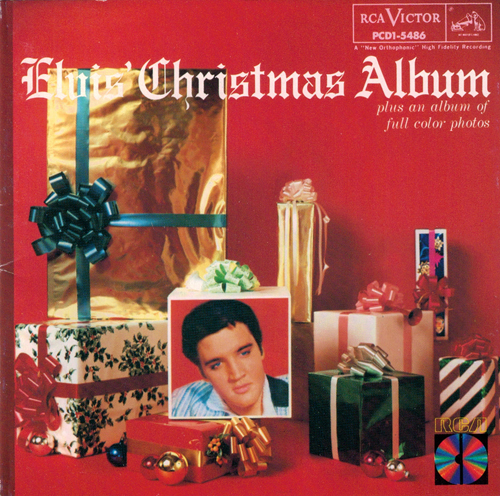
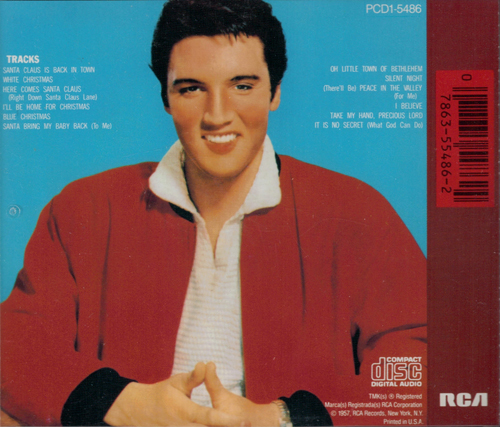
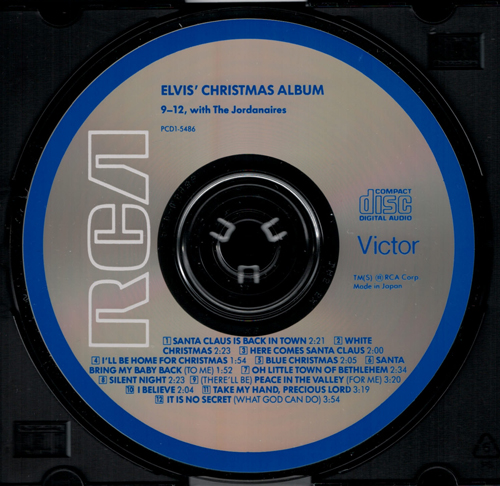
I thought it was time to throw some holiday cheer into keithhirsch.com with a Christmas CD…or two!  Described here are two rare Elvis Presley Christmas discs.

In 1984, RCA issued the Elvis Presley Merry Christmas album on CD in the U.S. and Europe.  Although one might expect this album to be a staple in the Elvis catalog, it is long out of print.  Merry Christmas was issued in the U.S. under catalog number PCD1-5301, and the disc was pressed in Japan by Denon.  In Europe, Merry Christmas was released under catalog number PD85301, and the disc was pressed in West Germany at the Polygram and PDO (Philips-DuPont Optical) plants.  The U.S. version was in print for only a very short time and is extremely rare.  It draws considerable attention from collectors in online auctions.  The European issue stayed in print longer, and while more common than its U.S. counterpart, is still quite rare.

Shown below are scans of the two versions of Merry Christmas along with the cover and back insert.  Happy Holidays!


elvis-merry-christmas-japan.jpg

The U.S. issue of Elvis Presley Merry Christmas (RCA catalog number PCD1-5301). This disc was pressed in Japan by Denon for release in the U.S. in 1984 and is very rare, as it went out of print quickly.


elvis-merry-christmas-wg.jpg

The European issue of Elvis Presley Merry Christmas (RCA catalog number PD85301). This disc was pressed in West Germany for release in Europe. This particular copy has “MADE IN W. GERMANY BY PDO” stamped on the play side in the hub area.


elvis-merry-christmas-cover-2.jpg

The cover for the U.S. issue of Elvis Presley Merry Christmas (RCA catalog number PCD1-5301). The cover for the European issue is very similar.


elvis-merry-christmas-back-insert.jpg

The back insert for the U.S. issue of Elvis Presley Merry Christmas (RCA catalog number PCD1-5301). The back insert for the European issue is very similar.

Among my latest acquisitions is a very rare Japanese Target CD pressing of Led Zeppelin “IV”.  Shown below, this disc bears the original European catalog number of 250 008.  The disc was pressed at the CBS/Sony plant, as evidenced by “CSR COMPACT DISC” repeating in the plastic ring.  The matrix code is “DIDZ-10058 31A3”.

Based on the catalog number, this disc is believed to be an early European issue.  The red coating with “aluminum” text and aluminum target squares was only used on a handful of Target CDs.  In my experience, this is one of the rarest Target CDs.


zeppelin-4-target-post.jpg

The vast majority of early Japanese pressings of CBS/Sony titles for the U.S. market have ”MADE IN JAPAN” or “MANUFACTURED IN JAPAN” stamped along the perimeter at the end of a copyright statement.  Certain discs, however, have a “MADE IN JAPAN” sticker affixed beneath the CD format logo at 3 o’clock.

It is not clear to me why the stickers were used rather than the conventional stamp along the perimeter, but in my experience, these stickered discs are very rare.  Shown below are two Japan-for-U.S. issues of Bruce Springsteen Born to Run (CBS, catalog number CK 33795).  The first copy has the “MADE IN JAPAN” sticker at 3 o’clock.  The matrix code is “35DP-21-1 1A1” in a crude font.  This crude matrix code font is indicative of a very early Japanese CBS/Sony pressing.  The disc also has “MANUFACTURED BY CBS/SONY RECORDS INC.” stamped on the clear plastic ring.

The second copy of Born to Run has the conventional “MADE IN JAPAN” stamp along the perimeter.  This disc has the same matrix code as the stickered version, but it has “CSR COMPACT DISC” repeating in the plastic ring.

I also have stickered versions of REO Speedwagon Hi Infidelity (Epic, catalog number EK 36844), Boz Scaggs Silk Degrees (CBS, catalog number CK 33920), and Toto Toto IV (CBS, catalog number CK 37728).  Each title also exists as a Japanese CBS/Sony pressing with “MADE IN JAPAN” stamped along the perimeter.


springsteen-born-to-run-japan-sticker.jpg


springsteen-born-to-run-japan-no-sticker.jpg

Next »